My background is in plant operations: control room, reactor front end, movements and utilities. I have walked a lot of rounds on paper.
If you have done the same, you know what a round really is. It is the one time in the shift that somebody stands next to the equipment. You hear a bearing long before anybody measures it. You notice the sight glass that is a little lower than yesterday, the pump that is warmer than its twin, the drip that was not there on Tuesday.
Then you write a number in a box, the sheet goes in a tray, and that is usually the last anybody sees of it.
The record nobody reads
The operator's part works. They walk, they look, they notice. What fails is the next step.
The reading sits in a binder. The person who could have looked at that bearing temperature over six weeks never sees it. Months later somebody asks what the plant looked like on a particular day, and a good operations team ends up going through boxes of paper to answer a simple question.
Software is the obvious answer, and I hold a plain view about it. If it makes the round harder, the round gets done badly, and the record ends up worse than the paper it replaced.
That is the gap I built Amberhold for.
The record between maintenance jobs
Most sites already have a maintenance system: SAP PM, Maximo or something like them. It is the system of record for maintenance. Notifications, work orders, spares, history against the asset register. It answers the question “what work was done on this equipment?”
There is a second question: “what did the plant look like between the work?”
That one is the operator's. It is answered every shift, on a round. Some maintenance systems can hold rounds too. The gap opens where the operator's routine observations are not recorded there, or anywhere else the maintenance and reliability side can reach.
The reliability profession has a name for taking it seriously: operator-driven reliability, or ODR. SKF, the bearing maker, says it pioneered the idea in 1997. You will also hear operator care, basic care and autonomous maintenance. The names differ. The idea is the same: the people nearest the equipment, every shift, with a defined list, leaving a record somebody else can use.
Every version of it stands or falls on that last part. I have written more about it in What is operator-driven reliability?
What Amberhold does
Amberhold is the operator's record. Operator rounds and plant inspections are done on a phone, one point at a time.
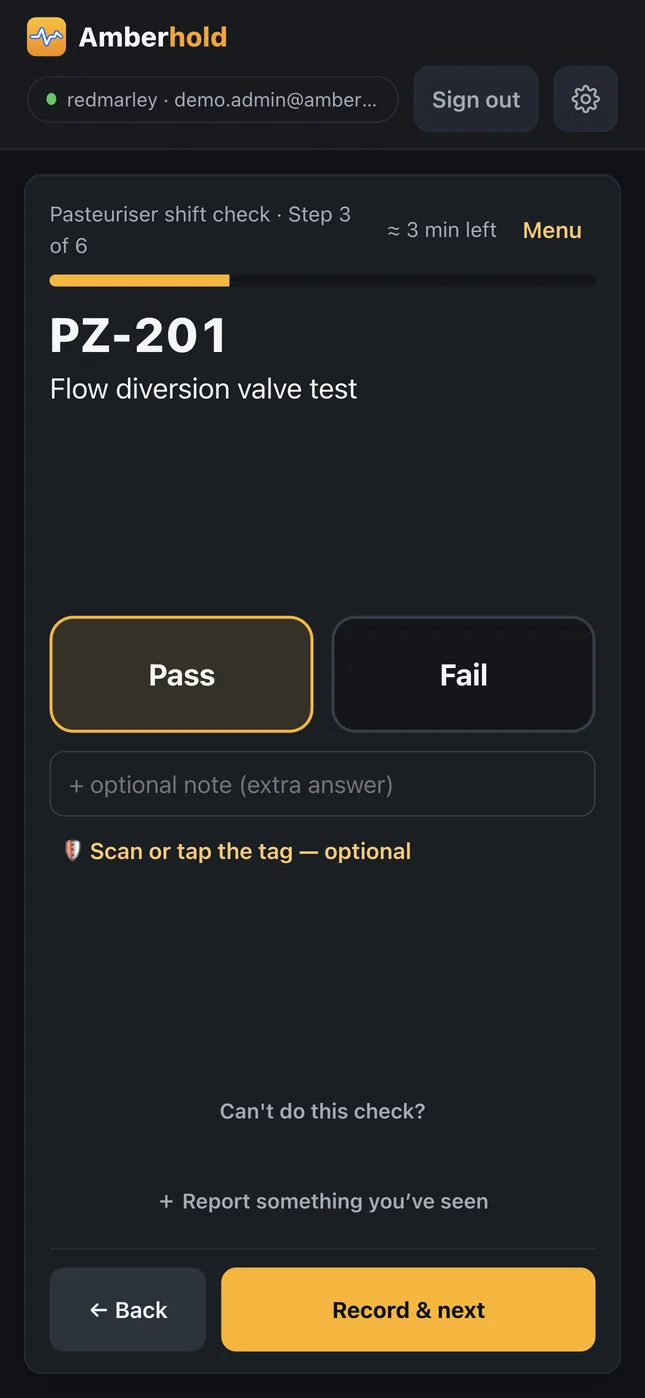
A few things I held to while building it:
- Each reading keeps the limit it was judged against. Limits change. Equipment gets moved. A reading taken in March still says which limit applied in March and which equipment it was taken on. Nothing later rewrites it.
- A reading outside the site's own limit is flagged as it is typed. It shows which limit it crossed and opens an item that stays open until a manager or site administrator answers it, with the decision recorded against their name and the time. The limits are the site's. Amberhold never invents one.
- A missed round stays visible. It shows as overdue until it is completed late or acknowledged with a reason. A check that did not happen is recorded as exactly that. If you cannot see the gaps, you cannot trust the rest.
- The record is append-only. A re-check adds an entry. The earlier reading stays, attributed and marked superseded. Corrections are added, never written over.
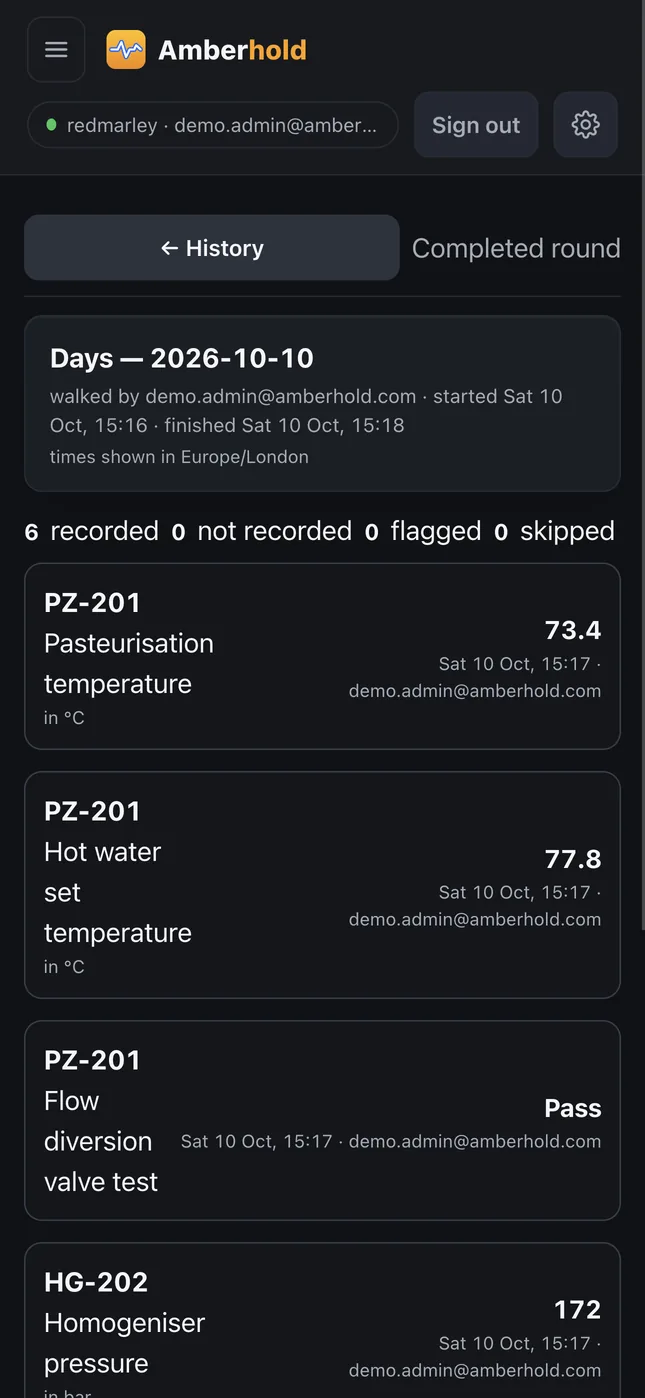
- The tag identifies the equipment. A QR label, or an NFC tag read in the Amberhold app, tells the record which equipment the check is about. It does not show that somebody stood there, and I will not claim it does.
- Temporary controls sit alongside the rounds. An inhibited alarm or a bypass is declared with a reason, a check is scheduled each shift, and it is cleared only with a recorded reason. It does not quietly expire.
- The readings come out. As CSV, or through a read-only API, into Excel, Power BI or anything that reads REST. Power BI has been connected to a live Amberhold site and refreshed on a schedule with nobody signed in.
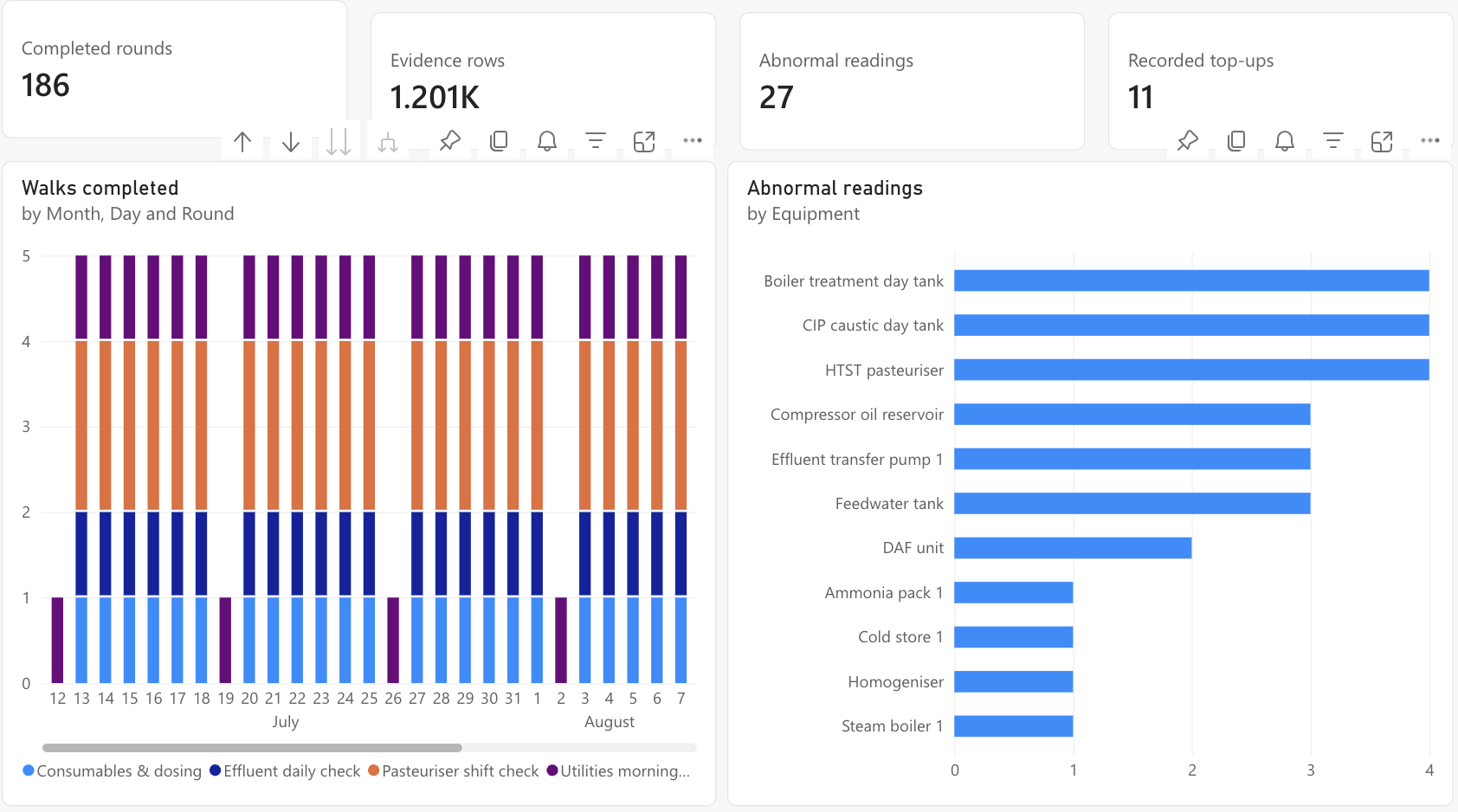
Amberhold records against the equipment names and functional locations your plant already uses, so a finding on a round can be raised in your CMMS against the same equipment, by the people whose job that is.
What it does not do
I would rather say this plainly than have you find out later.
- Amberhold does not raise work orders and writes nothing into your CMMS. The work order belongs in the maintenance system, raised by somebody who has read the finding.
- Amberhold does not predict failures, diagnose causes or calculate OEE. It gives the people who do those things the operator record they have been working without.
- It is not an alarm, a protection system or a process-control system. Your plant's alarms are unchanged.
- It does not certify compliance or make a plant safe. People do that. Amberhold keeps what they found and what they decided.
The rule I hold it to
Amberhold has to do both: a round that is simpler to do properly on a phone, and a record the maintenance and reliability side can use. If it is not simpler for the operator, the second half never arrives.
It has been walked on real rounds at a live process plant.
If this sounds like your site
If you recognise the binder, I would like to hear how your site handles it.
And if you have a blank round sheet you are allowed to share, send it to me. I will rebuild that one round in Amberhold and send you a short recording of it. It is free and there is no obligation: rebuild one round.